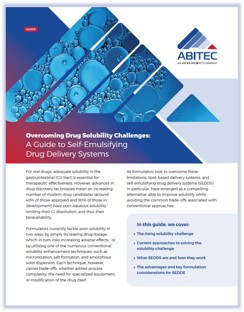
Overcoming Drug Solubility Challenges: A Guide to Self-Emulsifying Drug Delivery Systems
Solubility in the gastrointestinal (GI) tract is essential for therapeutic effectiveness of oral drugs. However, an increasing number of modern drug candidates (around 40% of those approved and 90% of those in development) have poor aqueous solubility* limiting their GI dissolution, and thus their bioavailability.
Formulators can tackle poor solubility by simply increasing drug dosage but that risks increasing adverse effects*. Or they can use various solubility enhancement techniques which might require additional drug modifications, process complexity or specialized equipment.
Self-emulsifying drug delivery systems (SEDDS) have emerged as a compelling alternative, avoiding the trade-offs that come with these conventional approaches.
Learn how to overcome drug solubility challenges with self-emulsifying drug delivery systems
Download our guide to self-emulsifying drug delivery systems (SEDDS) which covers:
- The rising solubility challenge
- Current approaches to solving the solubility challenge
- What SEDDS are and how they work
- The advantages and key formulation considerations for SEDDS
Get the white paper today and find out how SEDDS could help you overcome your drug delivery challenges
*Xie B, Liu Y, Li X, Yang P, He W. Solubilization techniques used for poorly water-soluble drugs. Acta Pharm Sin B. 2024;14(11):4683-4716. doi:10.1016/j.apsb.2024.08.027